
Meta description: Choose a business domain name with 9 clear rules: keep it short, check trademarks and extensions, and compare renewal prices first.
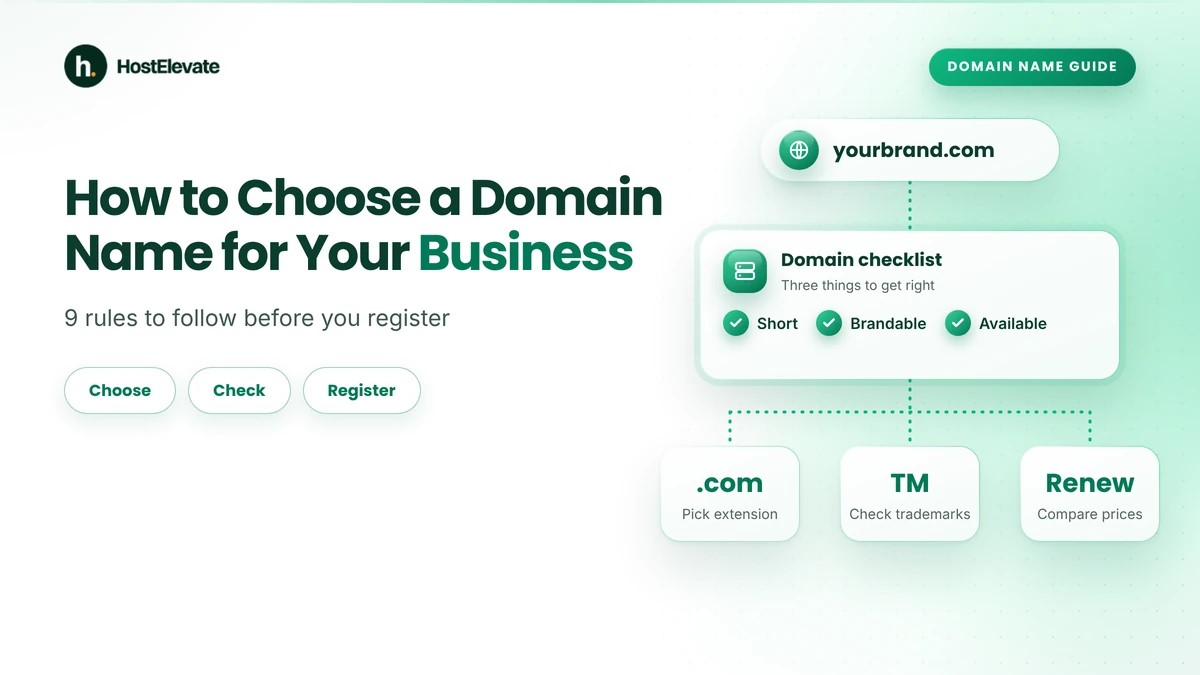
To choose a business domain name, pick one that is short, easy to spell, tied to your brand and suitable for long-term use. Before you register it, check the extension, availability, existing trademarks and renewal price. A strong business domain name also has to work across your email, social profiles and marketing.
A good domain does more than give people an address to type. It builds your brand identity, makes your website easy to share and gives customers one consistent way to find you online. This guide gives you nine practical rules for choosing a business domain name, plus the final checks to complete before you pay, so you can avoid costly mistakes.
Table of Contents
- What Is a Business Domain Name and Why Is It Important?
- How to Choose a Business Domain Name: 9 Rules
- Which Domain Extension Should You Choose?
- Does a Business Domain Name Affect SEO?
- What to Check Before Registering a Business Domain Name
- Common Business Domain Name Mistakes to Avoid
- How to Register Your Business Domain Name
- How to Protect and Manage Your Business Domain Name
- Frequently Asked Questions
- Summary
What Is a Business Domain Name and Why Is It Important?
A domain name is the human-readable address people use to reach a website, such as yourbrand.com. It connects a memorable name to the technical infrastructure that sends visitors to the right online destination. A business domain name is simply the domain you use to represent your company online.
It is important because it is part of your digital identity. It appears on your website, your email addresses, your marketing materials and your customer communications, so a clear and consistent business domain name makes it easier for people to recognise and revisit you.
A domain name does not automatically improve search rankings, guarantee customer trust or protect a trademark. Its real value comes from being memorable, relevant to your brand and properly managed.
How to Choose a Business Domain Name: 9 Rules
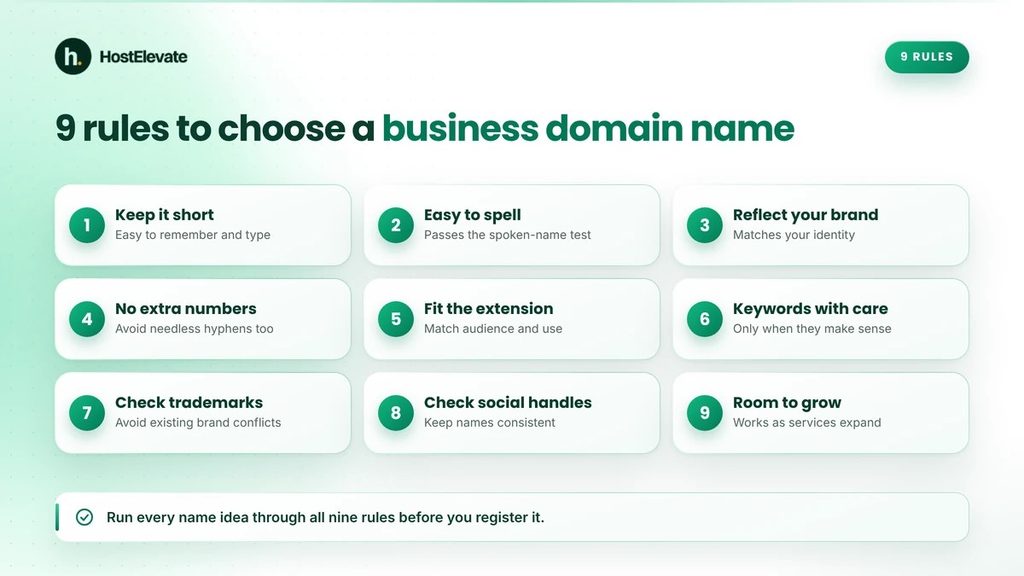
Choosing a business domain name becomes easier when you judge every idea against the same criteria. Use these nine rules before you decide which name to register.
Keep Your Domain Name Short and Simple
A short domain is easier to remember, type and share. Long names with several words are hard to communicate, especially when someone hears the address instead of seeing it written down. For example:
| Less practical | Simpler alternative |
| thebestprofessionaldesigncompany.com | brandstudio.com |
| youraffordablewebhostingprovider.com | hostbrand.com |
| myonlinebusinessservicesworld.com | businessname.com |
These are illustrative examples, not availability recommendations. Aim for a business domain name that communicates your identity without extra words. No universal character limit guarantees a good domain, so put clarity ahead of an arbitrary length.
Make It Easy to Spell and Pronounce
A good business domain name should be easy to understand when someone hears it in a conversation, presentation or phone call. Try the spoken-name test:
- Say the domain name aloud.
- Ask someone to write it down without seeing it.
- Check whether they spell it correctly.
- Notice whether they ask how a particular word is written.
Avoid unusual spellings, confusing abbreviations and combinations that can be read in more than one way. Replacing a common word with a shortened version may look distinctive, but it can make the correct spelling harder to remember.
Choose a Name That Reflects Your Brand
Your business domain name should support the identity you want to build. You can use your company name, a shortened brand name or a distinctive mix of words related to your products and services. Before you decide, ask:
- Does the name match your business identity?
- Will customers understand and remember it?
- Does it sound professional when spoken aloud?
- Can it represent your business if your services expand?
- Does it look consistent with your existing brand materials?
A brandable name stays relevant even when your product range changes, which helps when you plan to serve new markets or add services later.
Avoid Unnecessary Numbers and Hyphens
Numbers and hyphens make a domain harder to communicate. Someone who hears my-business24.com may not know whether to type 24, write twentyfour or include the hyphen. Some established brands do use numbers or hyphens, but they should not be added just because your preferred version is taken. A cleaner business domain name is easier to share by voice and less likely to cause typing mistakes.
Choose a Domain Extension That Fits Your Audience
The domain extension is the ending of a web address, such as .com, .org, .net or .co. Different extensions suit different purposes, so choose one that fits your brand, audience and intended use.
| Extension | Common use |
| .com | General commercial and international websites |
| .org | Organisations and communities |
| .net | Technology and network-related projects |
| .co | Companies and brand-oriented websites |
| .io | Technology products and software projects |
| .store | Online retail and ecommerce |
| Country-code extensions | Websites targeting a particular country or market |
The .com extension is widely recognised, which makes it familiar for many international brands, but it is not mandatory. A relevant alternative can work well when it suits your company. Do not pick an extension only because it is available or cheap. Check its registration requirements, renewal price and any restrictions before you buy.
Include Relevant Keywords Only When They Make Sense
Some companies add a descriptive word to their domain, such as a service or industry term. A photography brand might use studio, for example. Relevant words can help people understand what you offer, but they should not make the business domain name long or generic.
Avoid keyword stuffing. The priority should be a memorable brand name, not an attempt to fit every target keyword into the web address. The section on SEO below explains what Google says about keywords in domain names.
Check Trademark Conflicts and Existing Brands
Before you register a business domain name, check whether another organisation already uses the same or a confusingly similar name. An available domain is not automatically safe to use. An existing trademark can create a conflict even if that exact domain has never been registered. Carry out these checks:
- Search Google for the proposed business name.
- Search the trademark databases for the countries where you plan to operate.
- Look at companies working in the same industry.
- Look for similar names and spellings.
- Ask whether the name could confuse customers.
- Get professional legal advice if a possible conflict appears.
The World Intellectual Property Organization (WIPO) publishes trademark information and search resources, and the right database depends on where you operate.
Check Social Media Username Availability
Your domain and social profiles should ideally use the same or a closely related brand name. Before you finalise the business domain name, check availability on the platforms your audience uses, such as:
- YouTube
- TikTok
- X
You do not need an account on every platform. Focus on the channels where you intend to build an audience, and if the exact username is taken, decide whether a consistent alternative would avoid confusing customers. Brand consistency across your website, email and social profiles makes you easier to recognise.
Choose a Name That Can Grow With Your Business
A business domain name should stay useful as your company develops. A business that starts with one service may later add related products, subscriptions or international markets, and a domain that describes only one narrow product can become restrictive. Before registering, ask yourself:
- Could the business add more services?
- Will the name still make sense in several years?
- Does it work for customers in different countries?
- Can it represent the wider brand rather than one product?
- Would future growth force you to change the domain?
A flexible name gives you room to develop your brand without changing its main online identity.
Which Domain Extension Should You Choose?
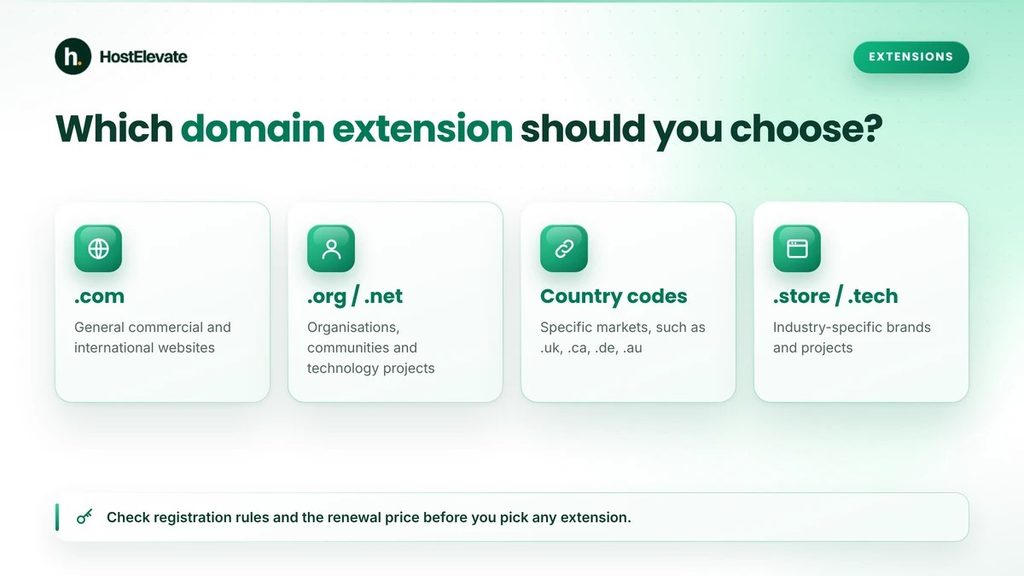
Choosing the extension is an important part of selecting a business domain name. The right option depends on how you want customers to see your brand and which markets you want to serve.
.com for General International Businesses
.com is familiar for commercial websites and is often the first option companies consider. It suits many kinds of sites, including company websites, online services, ecommerce stores, professional portfolios and international brands. If your preferred .com name is available and appropriate, it is a reasonable starting point.
Country-Code Extensions for Specific Markets
Country-code top-level domains (ccTLDs) are tied to particular countries. Examples include:
- .uk for the United Kingdom.
- .ca for Canada.
- .de for Germany.
- .au for Australia.
A country-code extension can help when a business mainly serves customers in one market. Check the registry’s eligibility and registration requirements before choosing one.
Alternative Extensions for Specific Industries
Other extensions can signal a certain type of business or project. For example, .store may suit an ecommerce brand, while .tech can fit a technology-focused company. The extension should make sense to your audience and be easy to explain and remember. A less familiar extension is not automatically unsuitable.
Does a Business Domain Name Affect SEO?
Many owners worry that the wrong domain will hurt their search visibility, so it helps to know what Google actually says. In its SEO Starter Guide, Google states that the keywords in a domain name or URL path alone have hardly any effect. It also advises that when you pick the name of your site, you should do what is best for your business, and it says the extension matters only if you target a specific country’s users.
In practice, this means you should not choose a business domain name by trying to match a search phrase. A memorable, brandable name that people trust and type correctly will usually serve you better than an awkward keyword string. Rankings come from useful content, a sound technical setup and a good experience, and the domain is only one small part of that picture.
What to Check Before Registering a Business Domain Name
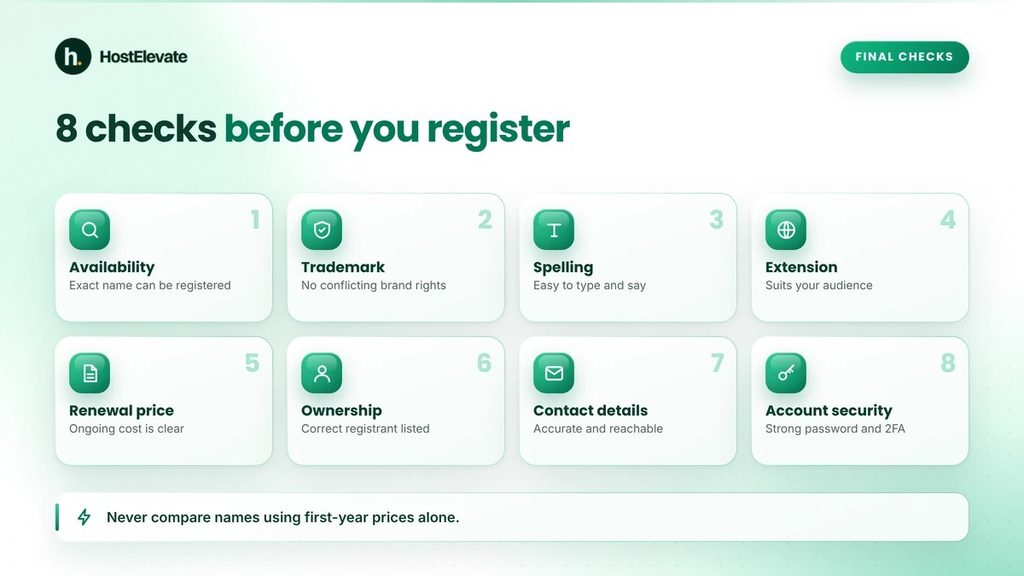
Once you have chosen a candidate, complete a final review before paying for registration.
| Check | What to verify | Why it matters |
| Availability | The exact domain can be registered | Prevents selecting an unavailable name |
| Trademark | No conflicting existing brand rights | Reduces potential legal problems |
| Spelling | The name is easy to type and pronounce | Helps prevent customer confusion |
| Extension | The extension suits the audience | Keeps the domain relevant |
| Renewal price | The ongoing cost is clear | Helps with long-term budgeting |
| Ownership | Your company or intended registrant is listed correctly | Keeps control with the right party |
| Registration details | Contact information is accurate | Helps with account and renewal management |
| Security | Registrar account protection is enabled | Reduces the risk of unauthorised changes |
Check the Registration and Renewal Price
Do not compare names using first-year prices alone. Some extensions have low introductory rates and higher standard renewal prices, and others require a minimum registration period of more than one year. Compare:
- The initial registration price.
- The annual renewal price.
- The transfer price.
- The minimum registration period.
- Applicable taxes.
- Additional registry or recovery fees.
You can review registration, transfer and renewal prices on the HostElevate domain pricing page and compare the initial and ongoing cost of your business domain name before ordering.
Common Business Domain Name Mistakes to Avoid
Even a promising name can cause problems if important checks are skipped.
Choosing a Name Only Because It Contains Keywords
A domain should represent your brand, not just repeat a search phrase. Keywords in a domain do not give a ranking bonus on their own.
Registering Without Checking Trademarks
An available domain can still conflict with another organisation’s trademark. Research existing brands before you complete registration.
Selecting a Complicated Spelling
Unusual spellings, unnecessary numbers and multiple hyphens make a business domain name harder to communicate.
Ignoring the Renewal Price
A low first-year price may not reflect the cost of keeping the domain for several years. Review the renewal price before you buy.
Using a Name That Restricts Future Growth
A domain focused too narrowly on one product or location may become unsuitable if your company expands.
Forgetting to Secure the Registrar Account
A weak password, an outdated recovery email or missing account security can put your domain at risk. Use a strong, unique password and enable two-factor authentication where it is available.
How to Register Your Business Domain Name
After your research, registering a business domain name is generally straightforward.
Search for Your Preferred Domain
Use a registrar’s domain search tool to check whether your chosen name is available with your preferred extension. If it is taken, look for a meaningful alternative instead of making random spelling changes.
Compare Available Extensions
Check whether other extensions suit your company. Compare registration and renewal costs, registration restrictions and any extra conditions.
Enter the Correct Registrant Details
Provide accurate contact information for the person or organisation that will hold the registration. Keep the account credentials secure and make sure the recovery email stays accessible.
Complete Registration and Configure DNS
After registration, manage the domain through your registrar account. You can set nameservers, DNS records and other settings to connect the domain to your website or email service. If you need help connecting a registered domain to a hosting server, follow our guide on how to point a domain to hosting using nameservers or an A record. If you still need a server, you can compare the web hosting plans available to pair with your new domain.
When you are ready to check available names, you can search and register a domain with HostElevate. If you already own a domain elsewhere, you can also transfer your domain and manage it in one place with your hosting.
How to Protect and Manage Your Business Domain Name
Registering the name is only the start. Your business domain name must stay under your control for as long as you use it.
Make Sure You Control the Domain
Register the domain with the correct registrant details and manage it through an account that your company controls. Keep access to:
- The registrar account.
- The account recovery email.
- Two-factor authentication.
- Domain contact information.
- Renewal settings.
- Transfer authorisation codes.
ICANN’s information for domain name registrants explains that registrants have rights and responsibilities, including managing, transferring and renewing a domain registration.
Do Not Rely on Someone Else to Hold It
Do not rely entirely on another person or agency to control a domain that represents your company. Make sure an appropriate person on your side can log in and manage it, and keep a record of who owns the registrar account.
Keep Renewals Under Review
A forgotten renewal can take your website and email offline. Check the renewal date and payment method regularly, and decide whether to turn on automatic renewal if your registrar offers it.
Frequently Asked Questions
What makes a good business domain name?
A good business domain name is memorable, easy to spell, relevant to the brand and suitable for long-term use.
Should I choose .com or another domain extension?
Choose .com when it suits your audience and is available, but a relevant alternative can also work well.
Do keywords in a domain name improve Google rankings?
No, Google says keywords in a domain name or URL path alone have hardly any effect on ranking.
How long should a business domain name be?
There is no fixed ideal length, but shorter names are generally easier to remember, type and say aloud.
Can I change my business domain name later?
Yes, but a change needs website, email, DNS and search-engine migration work, so choose carefully at the start.
Summary
Choosing a business domain name takes more than finding an available web address. The right name should be memorable, easy to spell, consistent with your brand and flexible enough to support future growth.
Before you register, check the extension, trademark position, social media availability, renewal price and ownership details. Avoid unnecessary numbers, complicated spelling and keyword-stuffed names, and keep the domain under your own control. A well-chosen business domain name gives your company a consistent online identity and a solid foundation for everything you build online.