
Web hosting renewal prices are usually higher than the price you pay at signup because the first-term price is a promotional discount. When that term ends, the plan renews at the provider’s regular rate, and add-ons such as domains and email renew on their own schedules.
This guide is for anyone buying hosting or looking at a renewal invoice. You will learn why renewal pricing goes up, where to find the renewal rate before you pay, how to work out the true cost over several years, and how to keep future bills predictable.
Key takeaways
- The first-term price is usually a promotion; renewals use the regular rate.
- Long prepaid terms often carry the deepest signup discount, so the jump at renewal can feel larger.
- Domains, email, SSL, and backups can renew separately from the hosting plan.
- Check web hosting renewal prices on the plan page, at checkout, in the terms, and in your order email before you pay.
- Compare hosts by total cost over two or three years, not by the first invoice.
What Are Web Hosting Renewal Prices and Why Do They Matter?

A web hosting renewal price is what you pay to keep the same plan after your first billing term ends. It matters because you pay it every term after the first, so over the life of a website it usually outweighs whatever the signup discount saved you.
Many site owners only notice the renewal price when the invoice arrives. By then, moving a site takes time and effort, so the cheapest option is to know the renewal rate before you buy.
Does Web Hosting Renewal Pricing Go Up After the First Term?
Yes, at most hosts the price goes up after the first term, because the signup price is a discount for new customers and renewals use the regular rate. Four things usually drive the increase.
The promotional period ends
Advertised prices are often valid for the first term only, and sometimes only for the longest billing cycle. When the term ends, the discount ends with it.
Long prepaid terms carry the deepest discounts
Hosts often show their lowest monthly equivalent for plans paid several years upfront. If you renew for a shorter period, the monthly equivalent rises even if the regular rate has not changed.
Free extras become paid renewals
A free domain, email service, or security add-on may be included only for the first year. For example, HostElevate includes a free .com, .net, or .org domain for the first year with yearly or longer billing, and the domain then renews at its regular rate.
Regular rates change over time
Hosts adjust regular prices when hardware, software licenses, or network costs change. Check whether your terms allow renewal rates to change and how much notice the provider gives.
Introductory Price vs. Renewal Price
When you compare web hosting renewal prices, remember that the introductory price applies to your first term only, while the renewal price applies to every term after it.
| Detail | Introductory price | Renewal price |
| When it applies | Your first billing term | Every term after the first |
| Discount | Usually a promotion for new customers | Usually the regular rate |
| Billing term | Often requires a long prepaid term | Depends on the term you choose at renewal |
| What to verify | Promotion conditions and the total you pay upfront | The next charge, the term length, and what is included |
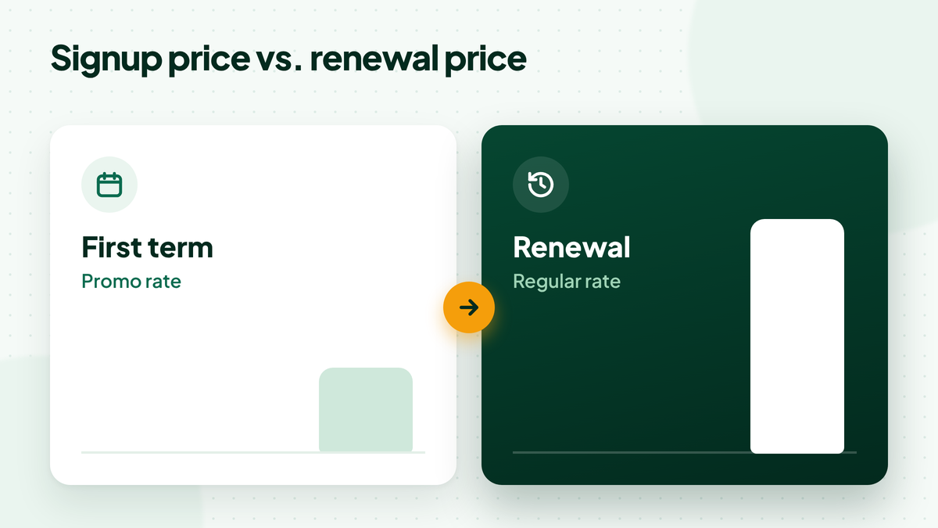
The first term uses a promotional rate; every renewal after it uses the regular rate.
What Else Raises Your Hosting Bill at Renewal?
Add-ons that renew separately can raise your bill even when the hosting rate stays the same. These are the most common hosting renewal charges:
- Domain renewal: a free first-year domain renews at the regular rate. Registrars must send renewal reminders about one month and one week before a domain expires, as ICANN explains in its domain renewal FAQs.
- Business email: if email is a separate product, it has its own renewal date.
- SSL certificates: free SSL renews automatically; paid certificates renew every year.
- Backups and security add-ons: these often bill on their own cycle.
- Taxes and currency conversion: paying in a currency your bank does not use adds conversion fees. HostElevate bills in both USD and PKR.
- Upgrades: a plan upgraded during the term renews at the higher plan’s rate.
How to Find Web Hosting Renewal Prices Before You Buy
You can find the renewal price before you pay by checking four places: the plan page, the checkout summary, the terms of service, and your order email.
- Read the fine print on the plan page. Look for “renews at” or a note under the price.
- Before you pay, compare the first-term total with the recurring amount in the checkout summary.
- Read the billing and renewal sections of the terms of service, including auto-renewal and price-change notice.
- Keep the order confirmation email and add the next due date to your calendar.
- After you buy, open the service in your client area to see the recurring amount and next due date.
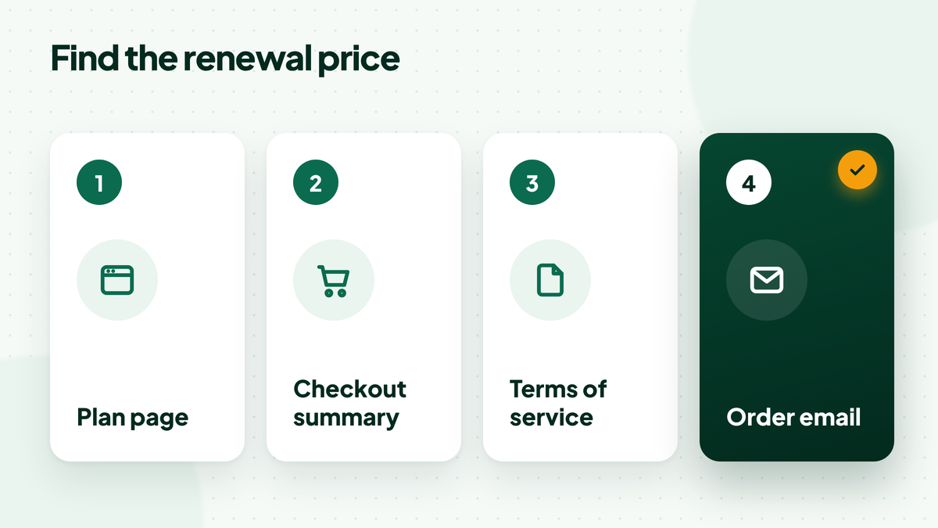
Four places to confirm the renewal price before you commit.
How to Calculate the True Cost of Hosting
The true cost of hosting is your first-term payment, plus every renewal, plus add-ons and taxes, over the time you expect to keep the site.
True cost = first-term payment + (renewal price × number of renewal terms) + add-ons + taxes and fees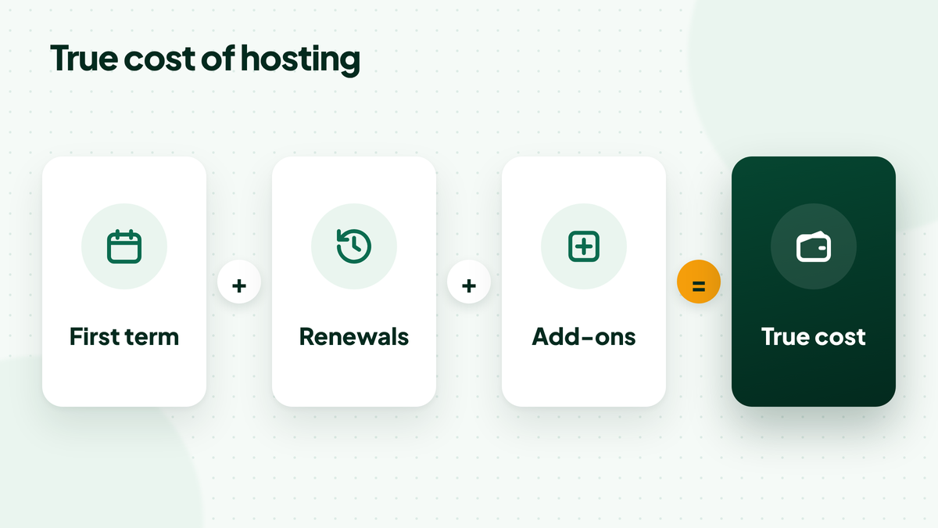
Add every renewal and add-on to see what hosting really costs.
Use this worksheet to compare web hosting renewal prices across hosts:
| Cost item | Year 1 | Year 2 | Year 3 |
| Hosting plan | First-term price | Renewal price | Renewal price |
| Domain | Often included | Domain renewal | Domain renewal |
| Email and add-ons | Add-on price | Add-on renewal | Add-on renewal |
| Taxes and fees | As charged | As charged | As charged |
A plan with a higher first year but a lower renewal rate often costs less over three years than a plan with a big signup discount.
How to Keep Hosting Renewal Costs Low
You keep renewal costs low by choosing the right term, removing what you do not use, and comparing plans before the due date.
- Choose a host that shows the renewal price next to the signup price, so the second invoice holds no surprises.
- Pick a billing term you can afford to renew, not just the lowest monthly equivalent.
- Remove unused add-ons and domains before the renewal invoice is created.
- Right-size your plan. If you pay for features you do not use, such as unlimited web hosting resources, a smaller plan may be enough.
- Ask support about renewal options a few weeks before the due date.
- Set a calendar reminder 30 days before each renewal.
Should You Switch Hosts Before Your Plan Renews?
Switch before renewal if the renewal price, speed, or support no longer fits your site, but compare the full cost and plan the move first. These signs it is time to switch web hosts help you decide.
Start at least two weeks before the due date so you are not rushing or paying for two plans. Follow a website migration checklist, test the site on the new server, and change DNS only when everything works.

HostElevate offers free website migration and a 90-day money-back guarantee on hosting, so you can test the new setup without a long commitment.
Frequently Asked Questions
Why do web hosting renewal prices increase?
Because the first-term price is usually a promotional discount for new customers. When the term ends, the plan renews at the regular rate, and free first-year extras such as a domain start renewing at their own price.
How can I find my hosting renewal price?
Check the plan page fine print and the checkout summary before you pay. After you buy, your order email and the service page in your client area show the recurring amount and the next due date.
Do all hosts raise prices at renewal?
No. Some hosts charge the same rate every term, and others show the renewal rate beside the signup price. Always confirm it in the checkout summary and the terms, not only in a headline price.
Is a low first-year price always the best deal?
Not always. A low first year with a high renewal rate can cost more over three years than a plan with a steady price. Compare the total cost for the time you plan to stay.
Can I move to another host before my plan renews?
Yes. Start the migration a few weeks before the due date, test the site on the new server, and cancel the old plan only after DNS points to the new host and email works.
Plan for Renewal Before You Buy
The renewal price, not the signup price, decides what hosting costs over the life of your site. Check web hosting renewal prices before you pay, add the cost of domains and add-ons, and compare hosts over two or three years.

If you want the renewal rate shown upfront, plus free SSL and free website migration, compare HostElevate web hosting plans.