

Unlimited web hosting means the host does not set a fixed cap on certain resources, usually storage, bandwidth, or the number of websites. It does not mean infinite resources. Every plan still limits CPU, memory, file count, and email sending, and a fair-use policy decides what normal use looks like.
This guide is for site owners comparing shared hosting plans that advertise unlimited features. You will learn what unlimited storage and unlimited bandwidth really cover, how unlimited differs from unmetered, which limits still apply, and what to check before you buy.
key takeways
- “Unlimited” usually applies to storage, bandwidth, or websites, never to CPU, memory, or processes.
- Unlimited storage is for files your website uses, not for backups, archives, or file sharing.
- Unmetered bandwidth is not measured; unlimited bandwidth has no published cap. Both still depend on port speed and fair use.
- A busy site usually hits CPU, memory, or process limits long before storage or bandwidth matters.
- Before you buy unlimited web hosting, read the plan specs, the fair-use policy, and the upgrade path together.
What Is Unlimited Web Hosting and Why Does It Matter?

Unlimited web hosting is a shared hosting plan where the provider does not publish a hard number for one or more resources. Instead of a fixed storage figure, the plan says “unlimited storage,” and a fair-use or acceptable-use policy sets the real boundaries.
It matters because the word changes how people compare plans. Two unlimited hosting plans can give your site very different amounts of CPU, memory, and disk speed. Those hidden limits decide how fast your pages load and how many visitors your site can serve at once.
What Does Unlimited Hosting Usually Include?
Unlimited hosting usually covers storage, bandwidth, websites, email accounts, or databases, but rarely all of them, and each one comes with its own conditions.
| Resource | What “unlimited” usually means | What to check |
| Storage | No fixed disk quota for website files | Inode limit and what counts as website use |
| Bandwidth | No published monthly traffic cap | Port speed, fair use, and CPU limits during traffic spikes |
| Websites | Add as many domains as the account allows | All sites share the same CPU, memory, and inodes |
| Email accounts | Create as many mailboxes as you need | Hourly sending limits and mailbox size |
| Databases | No fixed number of MySQL databases | Database size and query load on a shared server |
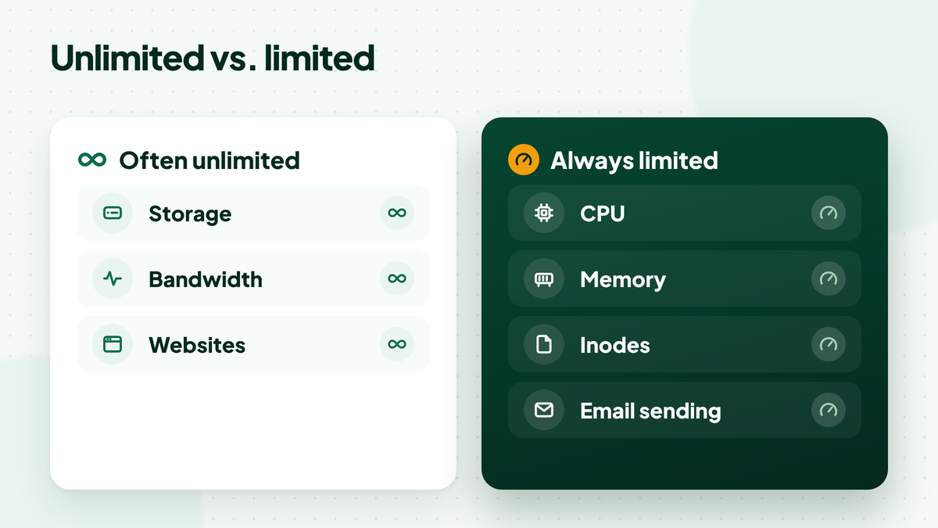
Unlimited covers some resources; the ones that decide speed always have limits.
Is Unlimited Storage Hosting Really Unlimited?
Unlimited storage hosting gives you no fixed disk quota, but the space is meant for files your website actually uses. Most plans also limit inodes and ban using the account as general file storage.
Inode limits
An inode is one file or folder. A WordPress site with plugins, cache files, and email can use a large number of inodes while using little disk space. When you reach the inode limit, the account cannot create new files, so uploads, updates, and incoming email fail. In cPanel, the statistics panel shows File Usage, and the Disk Usage tool shows which folders take the most space.
What counts as website use
Fair-use policies usually exclude backup archives, large video or download libraries, and files stored for people outside the website. If you need space for big media files, cloud storage or a VPS with a defined disk is a better fit.
Storage type matters more than storage size for speed. NVMe drives read files much faster than SATA SSDs, as our guide to NVMe vs SSD hosting explains.
Is Unlimited Bandwidth Really Unlimited?
Unlimited bandwidth means the host does not cap or bill your monthly data transfer, but no network has infinite capacity. Your real limit is the server’s port speed and the CPU and memory your account gets when traffic spikes.
In practice, a traffic surge rarely hits a bandwidth wall first. It hits the CPU or entry process limit, and visitors see slow pages or a 508 “Resource Limit Is Reached” error. Caching and a CDN help more than any bandwidth promise, for example putting Cloudflare in front of cPanel hosting.
Unlimited vs. unmetered bandwidth
Unmetered means the host does not measure your data transfer and instead limits speed at the network port. Unlimited means there is no published monthly cap, though the provider still watches for abnormal use. Neither term means unlimited server power.
| Term | What it means | What limits you |
| Unlimited bandwidth | No published monthly transfer cap | Fair-use policy, CPU, memory, and port speed |
| Unmetered bandwidth | Data transfer is not measured or billed | Fixed port speed and fair use |
| Metered bandwidth | A set monthly transfer allowance | The allowance, then overage fees or throttling |
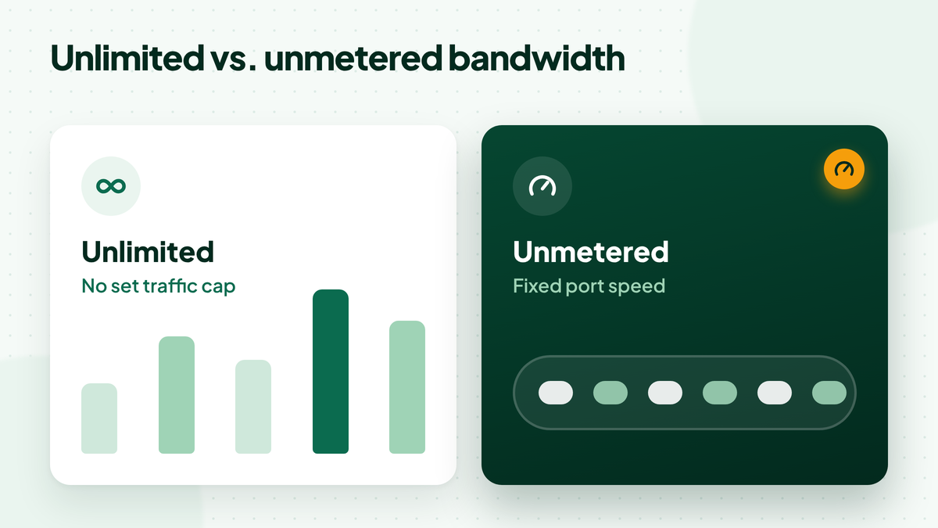
Unlimited removes the monthly cap; unmetered removes the meter but fixes the speed.
Can You Host Unlimited Websites on One Plan?
Yes, if the plan allows unlimited addon domains, but every site shares the same CPU, memory, and inode limits. Ten small brochure sites may run well on one account; ten busy online stores will not.
Each extra website also adds its own database, cron jobs, and email traffic. If one site is hacked or overloaded, the others on the account feel it too. Group related low-traffic sites together, and give busy sites their own plan.
Why Unlimited Hosting Still Has Limits
Unlimited hosting still has limits because every shared server has a fixed amount of CPU, RAM, and disk speed that many accounts share. To protect everyone, hosts set per-account limits, often with tools such as CloudLinux resource limits. The common ones are:
- CPU: how much processing power your account can use at once.
- Physical memory: the RAM available to your PHP processes.
- Entry processes: how many requests your site can handle at the same moment.
- I/O and IOPS: how fast your account can read from and write to disk.
- Inodes: the total number of files and folders in your account.
- Email sending: how many messages your account can send per hour.
When your site reaches one of these limits, the server slows it down or returns an error until usage drops. That is why two unlimited plans can perform very differently.
How Fair-Use Policies Work in Web Hosting
A fair-use policy explains what normal use of an unlimited resource looks like and what happens when an account goes beyond it. Look for four things in it:
- What the unlimited resource may be used for, such as website files and site traffic.
- What is excluded, such as backup archives, file sharing, and media streaming.
- What happens at the limit: a notice, throttling, or a request to upgrade.
- Which upgrade options are available when your site outgrows the plan.
Read the policy together with the plan’s spec sheet. For example, the HostElevate fair use policy sets out these rules for our hosting plans.
Is There Unlimited Cloud Hosting?

No cloud or VPS plan is truly unlimited, because each server gets a fixed amount of vCPU, RAM, and storage. “Unlimited cloud hosting” offers are usually shared hosting that runs on cloud infrastructure, with the same fair-use rules as any unlimited plan.
The upside of a cloud VPS is that its limits are clear and reserved for you. If your site outgrows shared limits, moving from shared hosting to a VPS gives you predictable resources and full root access.
| Consideration | Unlimited shared hosting | Cloud VPS |
| Resources | Shared, with per-account limits | Fixed vCPU, RAM, and storage for your server |
| Management | The host manages the server | You or a managed service run the server |
| Control | cPanel access, no root | Full root access |
| Best for | Blogs, portfolios, and brochure sites | Busy stores, apps, and custom software |
How to Choose an Unlimited Hosting Plan
Choose an unlimited hosting plan by checking the limits that the word “unlimited” leaves out.
- List which features are unlimited and which have fixed numbers.
- Find the CPU, memory, entry process, and inode limits in the spec sheet, or ask support.
- Read the fair-use and acceptable-use policies.
- Check email sending limits if you send newsletters or order emails.
- Confirm how often backups run and how you restore them.
- Ask what happens when you reach a limit and how upgrades work.
- Compare web hosting renewal prices, not only the first-term price.
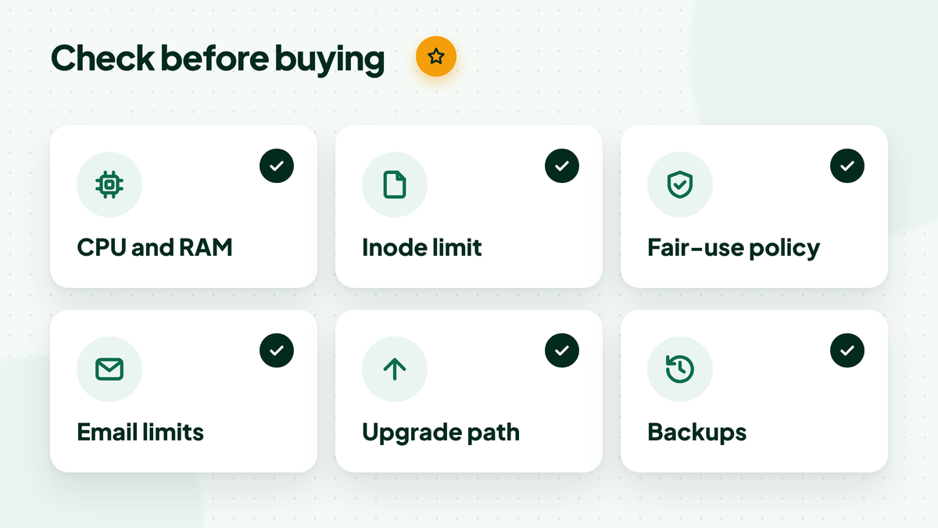
Six checks that show what an unlimited plan really gives you.
Frequently Asked Questions
Does unlimited web hosting mean unlimited storage?
Not always. Some plans make only bandwidth or websites unlimited. Even with unlimited storage, inode limits and fair-use rules decide how much you can store, and the space must be used for website files.
Is unlimited bandwidth really unlimited?
No network has infinite capacity. Unlimited bandwidth means there is no published monthly cap, but port speed, fair use, and CPU and memory limits decide how much traffic your site can handle.
What is the difference between unlimited and unmetered hosting?
Unlimited means there is no published cap on a resource. Unmetered means the host does not measure data transfer and limits port speed instead. Both still follow a fair-use policy.
Can I host multiple websites on an unlimited hosting plan?
Yes, if the plan allows addon domains. All sites share the account’s CPU, memory, and inode limits, so one or two busy sites can slow down the rest.
What happens if I go over a fair-use limit?
Usually the host contacts you first, then may throttle the account or ask you to upgrade. Repeated or abusive overuse can lead to suspension, so read the policy before you buy.
Is Unlimited Web Hosting Worth It?
Unlimited web hosting is worth it when your site’s normal workload fits comfortably inside the plan’s CPU, memory, and inode limits. Treat “unlimited” as a label for storage, bandwidth, or websites, then judge the plan on its real limits, its fair-use policy, and its renewal price. To compare clear plan specs with free SSL and free website migration, see HostElevate web hosting plans.