
You can start a web hosting business by choosing a model such as reseller hosting, picking a reliable infrastructure partner, setting up billing and support, and selling to a clearly defined niche. Reseller hosting is the lowest-risk way in, because the provider runs the servers while you build the brand and the client relationships.
This guide is for freelancers, web agencies and entrepreneurs who want to start a web hosting business without building a data center. You will learn the main business models, what to set up before launch, how to plan hosting packages and where your first customers come from.
Table of Contents
- What Is a Web Hosting Business and Why Is It Important?
- Which Web Hosting Business Model Should You Choose?
- How Do You Pick a Niche and Target Customers?
- What Do You Need Before You Launch?
- How Do You Choose an Infrastructure Partner?
- How Should You Design Your Hosting Plans?
- How Do You Handle Billing, Support and Legal Basics?
- How Do You Get Your First Customers?
- Common Mistakes When You Start a Web Hosting Business
- Launch Checklist
- Frequently Asked Questions
- Summary
What Is a Web Hosting Business and Why Is It Important?
A web hosting business sells storage, server resources and related services so that other people can keep websites online. Customers pay you for space, email, domains, security and support, and you either run the servers yourself or buy capacity from a provider.
It matters because every website needs a home, and customers stay with a host that is reliable and easy to reach. If you start a web hosting business with a clear niche and honest support, you can earn recurring revenue from clients who renew year after year. The challenge is that hosting is a service business: when a client’s site goes down, they call you, not your supplier.
Which Web Hosting Business Model Should You Choose?
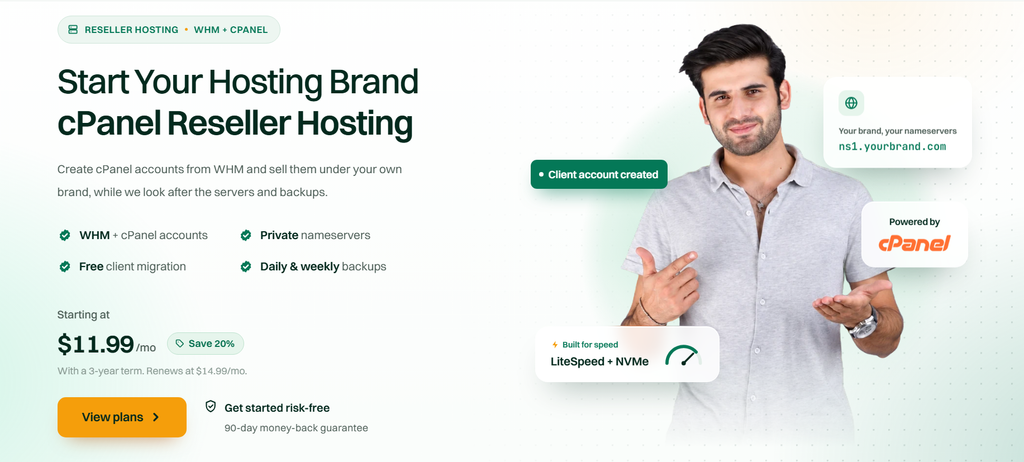
Reseller hosting is the best way to start a web hosting business for most people, because it needs the least technical work and the lowest upfront commitment. You rent a reseller account, split its resources into packages and sell them under your own brand.
In cPanel and WHM, a reseller is an account owner who also sells cPanel accounts to other users, and packages control the resource limits of each account, as explained in the cPanel guide to reseller accounts. Here is how the main models compare.
| Model | What you manage | Best for |
| Reseller hosting | Branding, clients, billing, first-line support | Agencies and freelancers entering hosting |
| VPS-based hosting | Server setup, control panel, security, updates | Technical founders who want more control |
| Owning hardware | Servers, networking, facilities and staff | Large, well-funded companies only |
If you start a web hosting business as a beginner, begin with reseller hosting and move to a VPS later when your client base needs more control. HostElevate offers reseller hosting for this purpose, and VPS plans come with full root access, a firewall and DDoS protection.
How Do You Pick a Niche and Target Customers?
To start a web hosting business well, pick a niche by choosing a group of customers whose hosting needs you understand better than a general provider does. A narrow focus makes your marketing cheaper and your support easier.
Good niches often come from work you already do. For example:
- Web design clients. If you build sites, hosting is a natural add-on.
- Local professionals. Dentists, lawyers and consultants need a site and email but no technical staff.
- Developers or agencies. They want control panels, staging and fast support.
- Region-specific audiences. Customers in a country or language community who prefer a local-feeling provider with billing in their own currency.
Write one sentence that describes who you serve and what you promise them. If you cannot say it clearly, your customers will not understand it either.
What Do You Need Before You Launch?
To start a web hosting business, you need a brand, a domain, a hosting platform, a website, a billing system and a way to handle support. Set these up in order, because each one depends on the one before it.

- Brand and domain. Choose a short, memorable name and register a matching domain on the HostElevate domain registration page.
- Hosting platform. Use a reseller account or a VPS with a control panel such as cPanel and WHM.
- Website. Explain your plans, your support process and your terms in plain language.
- Billing and client management. Use software that creates accounts, sends invoices and handles renewals automatically.
- Support channel. Decide how clients reach you and how quickly you promise to reply. Only promise what you can deliver.
How Do You Choose an Infrastructure Partner?
When you start a web hosting business, choose a partner by testing reliability, support quality and migration help, not by reading marketing claims. Your clients judge you by your partner’s performance, so a weak supplier becomes your problem.
Check these points before you commit:
- Control panel. Confirm that you get cPanel and WHM or a similar tool, with the ability to create packages.
- Resource limits. Understand disk, bandwidth and account limits, and how they change as you grow.
- Backups. Ask how often backups run and how long they are kept.
- Migration. You will move client sites onto your platform, so free migration help saves time. HostElevate offers free website migration, and you can read about it on the website migration page.
- Support. Send a test question and see how clear the answer is.
Note that the free domain offer on HostElevate hosting plans does not apply to reseller plans, so plan your domain strategy separately.
How Should You Design Your Hosting Plans?
When you start a web hosting business, keep your plans few, clear and based on what customers actually need. Two or three packages are enough at launch, and each one should have a clear purpose.
A common pattern is a starter package for a single site, a growth package for several sites and a package for agencies or heavier use. Decide on resource limits inside WHM so that no single account can use up the whole server. Describe each package by outcome, such as the number of sites and email accounts, and avoid vague words like “unlimited” unless your supplier truly allows it.
Set your own prices after you calculate your costs, your support time and a margin you can sustain. Do not copy a competitor’s number without knowing what sits behind it.
How Do You Handle Billing, Support and Legal Basics?
Before you start a web hosting business in earnest, automate billing, write simple support rules and put your legal terms in writing. Late invoices and unclear promises cause more trouble than technical faults do.
For billing, set up automatic invoices, reminders and account suspension rules. For support, create a short list of common questions and a standard way to log each request. For legal basics, publish terms of service, an acceptable use policy and a privacy policy.
Business registration, tax and data-protection rules differ by country, so speak with a qualified local professional before you launch.
If you want to sell domains, you normally work through an accredited registrar or a reseller program. Becoming a registrar yourself has strict financial, technical and staffing requirements, which ICANN describes in its registrar application instructions.
How Do You Get Your First Customers?
Most people who start a web hosting business find their first customers among people who already trust them. Start with your own network and past clients, then add channels that fit your niche.
- Existing clients. Offer to host the sites you already build.
- Free migration. Move a client’s site for them. It removes the biggest worry about changing hosts.
- Helpful content. Publish guides that answer the questions your niche searches for.
- Local and online communities. Answer questions honestly without pushing a sale.
- Referrals. Ask happy clients to recommend you.
Keep your promises small and your replies fast. In a service business, a client who feels looked after tells others.
Common Mistakes When You Start a Web Hosting Business
Most people who start a web hosting business fail from poor planning, not from technology. Watch for these mistakes.
- Selling to everyone. A vague message attracts nobody.
- Choosing a supplier on price alone. A cheap platform that fails costs you clients.
- Overselling resources. Packing too many accounts on one server slows every site.
- Ignoring backups. Keep your own backup plan in addition to your supplier’s.
- Skipping legal terms. Without written terms, disputes are hard to settle.
- Neglecting support. Slow answers drive renewals away faster than downtime.
Launch Checklist
Use this table to confirm you are ready to start a web hosting business and take your first order.
| Step | Done when |
| Choose a model | You know whether you are starting with reseller hosting or a VPS |
| Define a niche | You can describe your ideal client in one sentence |
| Pick a partner | You have tested their support and migration help |
| Set up a platform | Packages and limits exist in WHM |
| Build your website | Plans, terms and contact details are live |
| Automate billing | Invoices, renewals and reminders run on their own |
| Prepare support | You have a channel, a log and a reply target |
Frequently Asked Questions
Can I start a web hosting business with no technical skills?
Yes. With reseller hosting, your supplier manages the servers while you handle clients, billing and basic support.
Is reseller hosting profitable?
It can be, but results depend on your niche, costs and the number of clients you keep. Calculate your expenses and support time before you set prices, and avoid relying on income guesses.
Do I need my own servers to sell hosting?
No. Most new hosts rent capacity through a reseller account or a VPS. Owning hardware adds large costs and responsibilities that are rarely worth it at the start.
Do I need a license to sell web hosting?
Rules vary by country and by what you sell. Hosting itself usually needs normal business registration, while selling domains has extra requirements, so check with a local professional.
How long does it take to launch a hosting business?
A basic launch with a reseller account, website and billing can take a few weeks if you prepare carefully. Building a client base takes longer and depends on your marketing.
Summary
To start a web hosting business, pick a model that matches your skills, choose a niche, set up a platform, billing and support, and test everything before you accept your first order. Reseller hosting keeps the technical load low while you build your brand and your client relationships.
Work through the launch checklist, choose a partner you have tested, and keep your promises realistic. When you are ready, you can look at HostElevate reseller hosting, ask a question on the contact page, or explore more guides on the HostElevate homepage.